
Exam Performance Investigations · Foundation · Why “It’s Wrong” Is Not Enough
You got the question wrong. The score report tells you that much. It does not tell you why.
And the why is the most important thing, because a wrong answer is not one problem. It is four, wearing the same face.
Last time we walked the path a question travels on its way to a right answer.
Starting at the bottom of the picture:
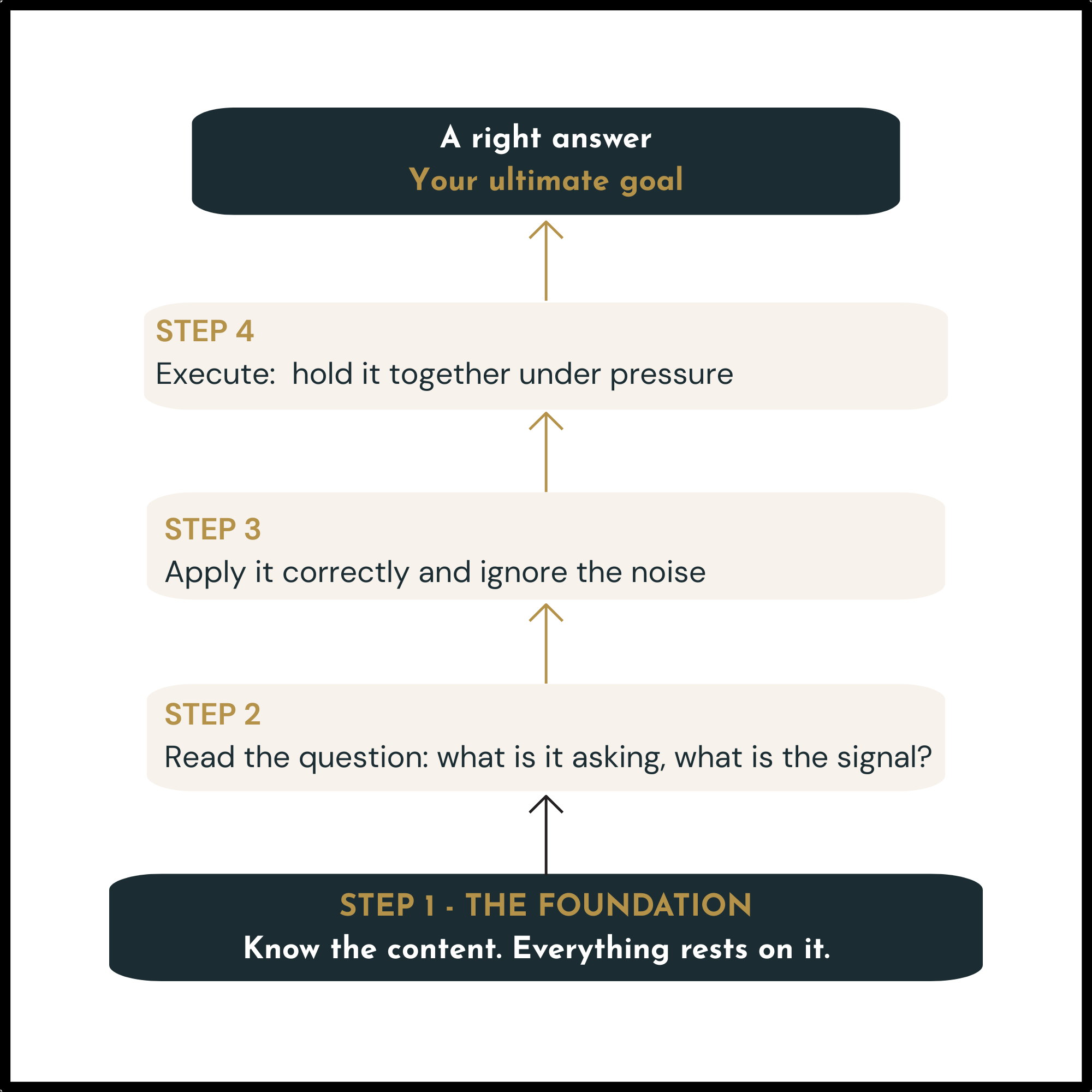
You know the content. Now, you must identify what the question is actually asking, then reach for the right rule and apply it. Next, you must hold it together under pressure, throughout the duration of the test
Four steps. A right answer needs all four to go right. A wrong answer means one of them broke.
Now look at what the score report shows you. Something not as useful. Just "wrong." Four completely different breakdowns, and they all print as the same mark on the page.
It is worse than that, because they also blur. Ask yourself why you missed a question weeks later and the answer comes back as one flat sentence: "I knew it and I blew it." That sentence covers a content gap, a misread task, a blocked retrieval, and a changed right answer. All four feel identical in memory. The very pressure that caused the miss is the thing that smudges your record of it.
So here is the problem that sinks most retake plans. If you can’t tell which layer broke, then "study more" is a guess. And three of the four layers are not fixed by studying at all. If you lost the points to a misread task or a changed answer, more hours with the book repairs a floor that was never cracked. You walk back in better read and lose the points in the same place.
That is the uncomfortable part, and it’s also the hopeful part.
Uncomfortable, because it means the honest first move is not to open the next study guide. It is to find out which steps cost you.
Hopeful, because once you know, the work gets smaller, not bigger. You stop studying everything again and start closing the one or two leaks that were actually draining your score.
So the useful question is not "did I study enough." You might have. The useful question is "which of the four broke, and how would I know?”
That’s the question that leads somewhere.
Next: the most dangerous layer of the four, because it is the one that feels the most like being ready.
— Dynell
